


How Long Does a Septic Drain Field Last?
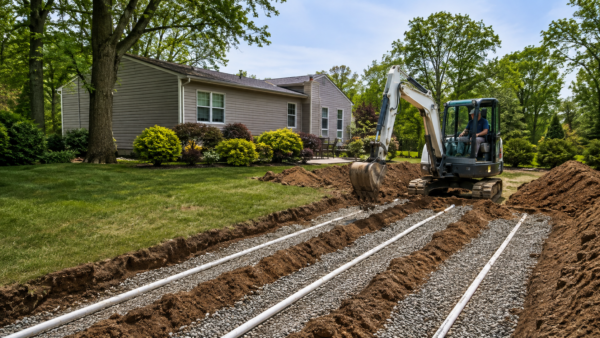
If your septic system is getting older, you may be wondering how much time your drain field has left before it needs attention. It is a fair question and one we hear regularly from homeowners across New Jersey. Unfortunately, there is no exact expiration date. Septic drain field lifespan depends on the system’s design, soil conditions, household water use, maintenance history and how well the original field was installed.
Quick answer: A properly designed and maintained septic drain field typically lasts about 20 to 30 years. Some well-cared-for fields continue working for 30 to 40 years, while overloaded or poorly maintained systems can fail considerably sooner. Once a drain field reaches 25 to 30 years old, homeowners should begin monitoring it more closely and planning ahead rather than waiting for an emergency.
How Long Does a Septic Drain Field Usually Last?
The U.S. Environmental Protection Agency explains that the natural biomat inside a drain field can thicken as the system ages. When that layer becomes too restrictive, the soil may no longer absorb wastewater effectively. This can cause ponding, wastewater surfacing in the yard or sewage backing up into the tank and household plumbing.
That is why 25 to 30 years is a useful planning benchmark. It is not a guaranteed failure date. A well-maintained 35-year-old field may still function properly, while a neglected 15-year-old field may already be experiencing problems.
The septic tank frequently lasts longer than the drain field. The EPA notes that a properly constructed concrete septic tank may last 50 years or more. For a more complete comparison of tank, pump, distribution-box and field longevity, read our guide to how long a septic system lasts in New Jersey.
What a Septic Drain Field Does
The drain field—also called a leach field or absorption field—is the part of the septic system that disperses and treats liquid wastewater after it leaves the tank. The tank holds back sludge and floating solids. The remaining liquid travels through a distribution box and into perforated pipes installed in gravel, chambers or another approved dispersal system.
The surrounding soil provides the final stage of treatment. A naturally occurring biological layer, known as the biomat, helps break down contaminants. Some biomat formation is normal and necessary. Problems develop when the layer becomes too thick, the soil remains saturated or solids escape the tank and clog the field.
What Determines Your Drain Field’s Lifespan?
Household water usage
Every gallon of water used inside the home eventually reaches the septic system. Long showers, leaking toilets and several back-to-back laundry loads can send wastewater into the field faster than the soil can absorb it. Spreading laundry throughout the week and repairing leaks promptly helps prevent hydraulic overload.
Pumping and maintenance history
Pumping does not repair or rejuvenate a drain field, but it helps keep damaging solids from reaching it. The EPA generally recommends inspecting a septic system every one to three years and pumping the tank every three to five years, depending on household size, tank capacity, water use and accumulated solids.
A tank may need pumping sooner when the bottom of the scum layer is within six inches of the outlet or the top of the sludge layer is within 12 inches of the outlet. Allowing solids to migrate into the drain field is one of the most common causes of premature failure.
Soil and groundwater conditions
Soil determines how quickly wastewater can move away from the field while still receiving adequate treatment. Dense clay, shallow bedrock and a high seasonal water table can make septic design more challenging. These conditions do not automatically cause failure, but they may require a larger field, pressure distribution, imported fill or another engineered design.
Northern New Jersey properties can have dramatically different conditions, even within the same municipality. Learn more about septic-system design for clay soils in Northern New Jersey.
What goes down the drain
Grease, wipes, coffee grounds, chemicals, excess food waste and other materials that do not break down easily add unnecessary solids or interfere with system performance. Septic systems are designed primarily for wastewater, human waste and toilet paper—not household trash.
Protection of the drain field
Vehicles, construction equipment, sheds, patios and other heavy loads can compact the soil or damage buried pipes. Trees planted too close to the field may eventually send roots into distribution lines. Roof drains, sump pumps and surface runoff should also be directed away from the field so rainwater does not compete with wastewater for absorption capacity.
Signs That a Septic Drain Field May Be Failing
Age alone does not establish that a field has failed. Pay closer attention to changes in how the system and surrounding yard behave.
- Multiple drains inside the home are slow or gurgling
- Sewage backs up into toilets, tubs or lower-level drains
- The ground over the field remains wet or spongy
- Standing water appears over or near the drain field
- Grass over the field becomes unusually green or fast-growing
- Sewage odors appear outdoors, particularly after rain
- Wastewater or dark liquid surfaces in the yard
A single slow sink may be an ordinary plumbing blockage. Slow drainage throughout the house, recurring backups and wet ground over the field are more concerning. The EPA recommends avoiding contact with backed-up sewage because it may contain harmful pathogens. Review the EPA’s information about resolving septic-system malfunctions if you are experiencing an active backup.
Can You Extend the Life of a Septic Drain Field?
You cannot reverse decades of normal aging, but good maintenance can help prevent avoidable damage and give a functioning field its best chance of reaching the upper end of its expected lifespan.
- Have the tank pumped according to actual solids accumulation and professional recommendations.
- Repair leaking toilets, faucets and plumbing fixtures promptly.
- Spread laundry and other high-water-use activities throughout the week.
- Keep vehicles, construction equipment and permanent structures off the field.
- Direct roof runoff, sump-pump discharge and surface drainage away from the system.
- Flush only human waste and toilet paper.
- Avoid septic additives marketed as a substitute for maintenance.
- Keep records of pumping, repairs, permits and system modifications.
The EPA does not recommend additives for ordinary domestic septic systems. The necessary microorganisms are already present, and some chemical or biological products may reduce drain field performance rather than improve it.
Can a Failed Drain Field Be Repaired?
It depends on what has failed. A clogged filter, damaged pipe, shifted distribution box or failed pump may be repairable without replacing the absorption field. Localized damage may sometimes allow for a partial repair.
However, soil that is extensively saturated, compacted or clogged by solids and excessive biomat usually cannot be restored with an additive or quick treatment. When the absorption area itself can no longer accept and treat wastewater, a new drain field is generally required.
Our guide to septic repair versus replacement explains which component problems can often be repaired and which conditions are more likely to require replacement. You can also learn more about ATS’s New Jersey septic-system repair services.
How Much Does Drain Field Repair or Replacement Cost in New Jersey?
Costs vary significantly based on the extent of the failure, field size, soil conditions, access, engineering requirements and the system approved by the local health department. The following ranges are useful for early budgeting but are not substitutes for a property-specific quote.
| Scope of work | Planning range |
|---|---|
| Minor or localized drain field work | $2,000–$5,000 |
| Partial drain field replacement | $5,000–$12,000 |
| Full drain field replacement | $10,000–$25,000+ |
| Complete new septic system | $20,000–$45,000+ |
Properties with clay soil, shallow bedrock, limited space or high groundwater may require a mound, pressure-distribution, aerobic-treatment or drip-dispersal system. These engineered systems generally cost more than conventional gravity systems. See our detailed guide to septic-system installation costs in New Jersey for a more complete breakdown.
New Jersey Drain Field Permits and Design Requirements
Residential septic systems that discharge 2,000 gallons per day or less are generally regulated under New Jersey’s Standards for Individual Subsurface Sewage Disposal Systems, N.J.A.C. 7:9A. Local health departments typically review and issue permits for the location, design, installation, alteration and repair of residential systems.
A replacement design may require soil and site evaluation, engineering plans, setback review and health-department approval. The correct design depends on the property rather than on a one-size-fits-all recommendation. Additional information is available through the NJDEP septic-system program.
How ATS Environmental Approaches Aging Drain Fields
No contractor can honestly guarantee that a functioning drain field has exactly five, 10 or 15 years remaining. What can be determined is whether the system is showing evidence of hydraulic overload, component damage, poor distribution or field failure.
ATS Environmental provides septic installation and replacement as well as repair services throughout New Jersey. Our installation team focuses on system design, engineering, permitting and construction rather than real-estate septic inspections.
- All-inclusive pricing: Engineering, permitting and installation are bundled into one quote.
- Fast quote turnaround: We provide initial pricing information without making homeowners wait days for basic answers.
- More than 30 years of New Jersey experience: We understand the clay, glacial till, shallow bedrock and seasonal groundwater conditions found throughout the state.
- Straightforward recommendations: We explain what can reasonably be repaired and when replacement is the more dependable long-term option.
Frequently Asked Questions
Does regular pumping make a drain field last longer?
Indirectly. Pumping does not repair or renew the field, but it helps prevent sludge and floating solids from leaving the tank and clogging the soil. Keeping solids out of the drain field is one of the most important ways to prevent premature failure.
Can I replace only the drain field and keep my existing septic tank?
Often, yes. An existing tank may be retained if it is structurally sound, properly sized and compatible with the approved replacement design. A site evaluation and local permitting review determine whether this is possible.
Is a 30- or 40-year-old drain field automatically failing?
No. Age is an important planning factor, but it does not establish failure by itself. Maintenance history, soil conditions, household use and current performance are more useful than age alone.
Do septic additives extend drain field life?
There is no reliable evidence that additives extend the life of a normally functioning residential drain field. The EPA advises that additives are unnecessary and that some products may impair field performance or threaten soil and groundwater.
How do I know whether my drain field needs repair or replacement?
Warning signs such as standing water, sewage odors, wastewater surfacing and recurring whole-house drainage problems indicate that professional evaluation is needed. The failed component and the condition of the absorption area determine whether repair remains practical.
Plan Before a Drain Field Problem Becomes an Emergency
If your drain field is approaching 25 to 30 years old, begin planning even if the system still appears to work. Gather installation and pumping records, monitor the field after heavy water use or rain and address warning signs promptly. Planning ahead provides more time for engineering, permitting and budgeting than an emergency backup allows.
ATS Environmental helps New Jersey homeowners understand their repair and replacement options with transparent, all-inclusive pricing. Call 800-440-8265 or contact ATS Environmental to discuss your property and receive a quote.